- Launched
- Apr 2026 (EN + ES, one week apart)
- Format
- 4x4 daily web puzzle
- Languages
- English, Spanish
- Live at
- tesserapuzzle.com ↗
- Maker
- Paul Cooper (solo)
- Build time
- 7 days (1 of 7 in 7)
- Pricing
- Free, no signup, no ads
- Press contact
- paul@cooperbanfield.co.uk

The story behind Tessera
A week after being made redundant from his role as Senior Designer at a Swedish energy startup, Paul Cooper shipped a daily word puzzle. It was one of seven projects he set out to publish in the seven days that followed, a self-imposed sprint to find out, in public, what an AI-operated design and build practice can actually output when the only constraint is throughput.
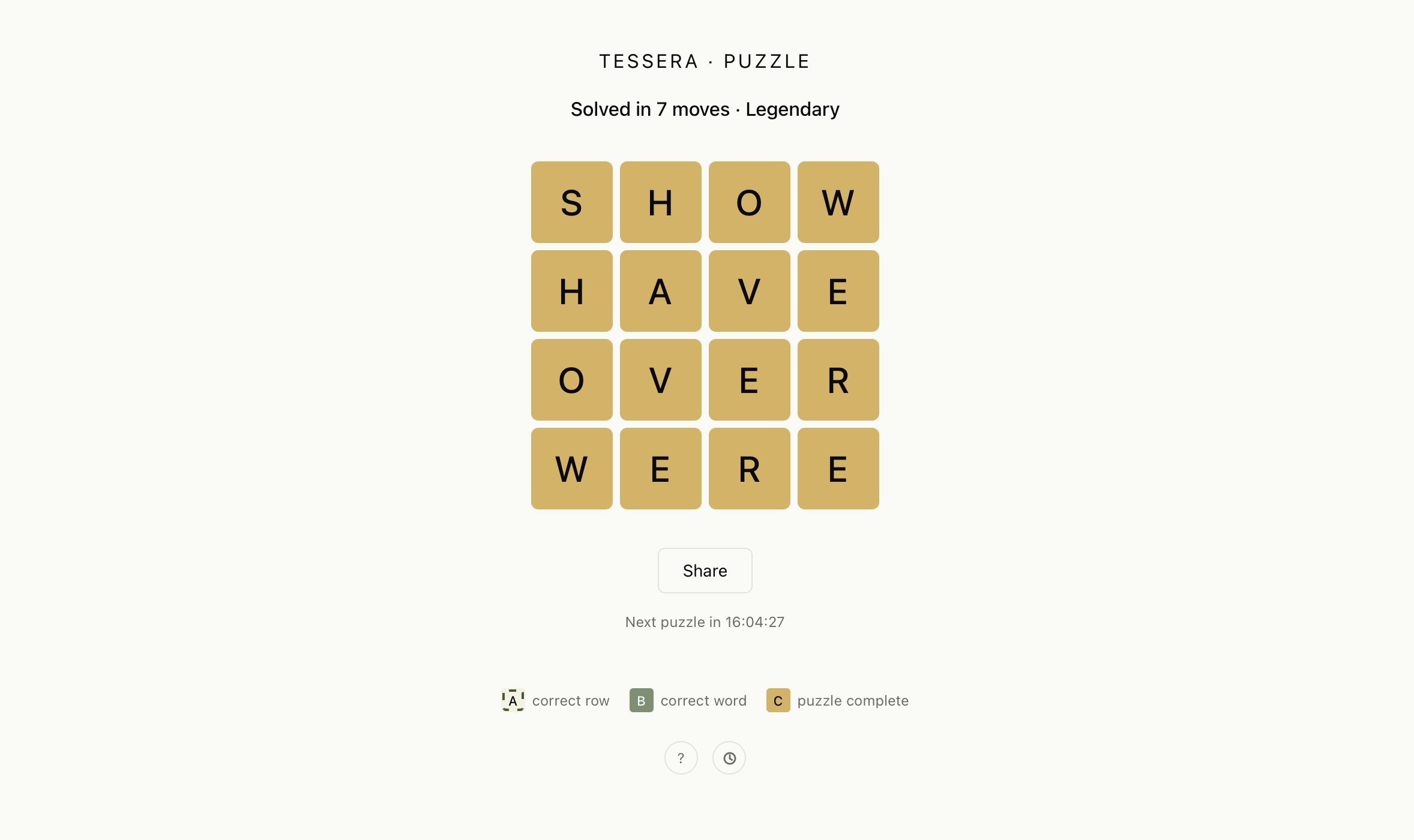
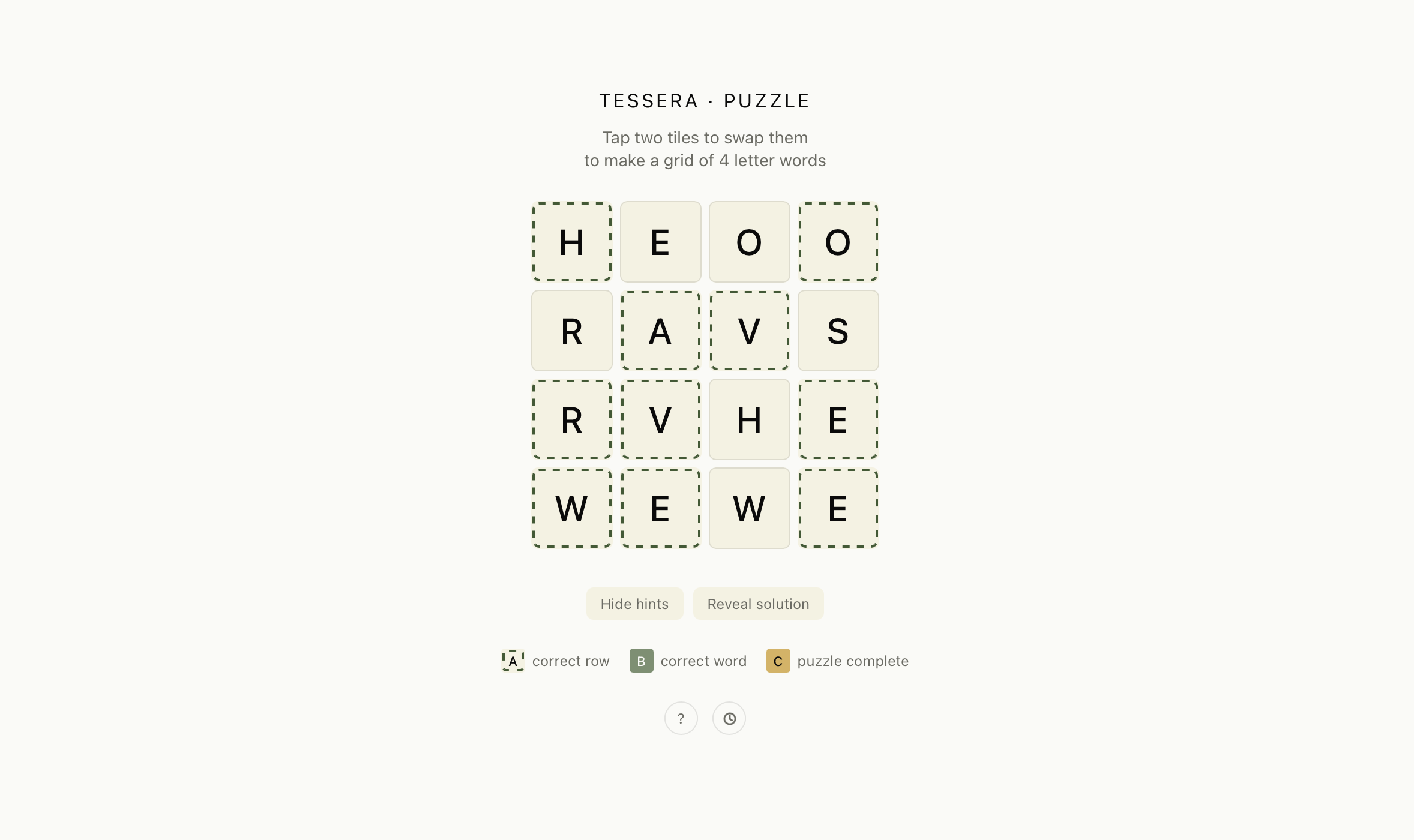
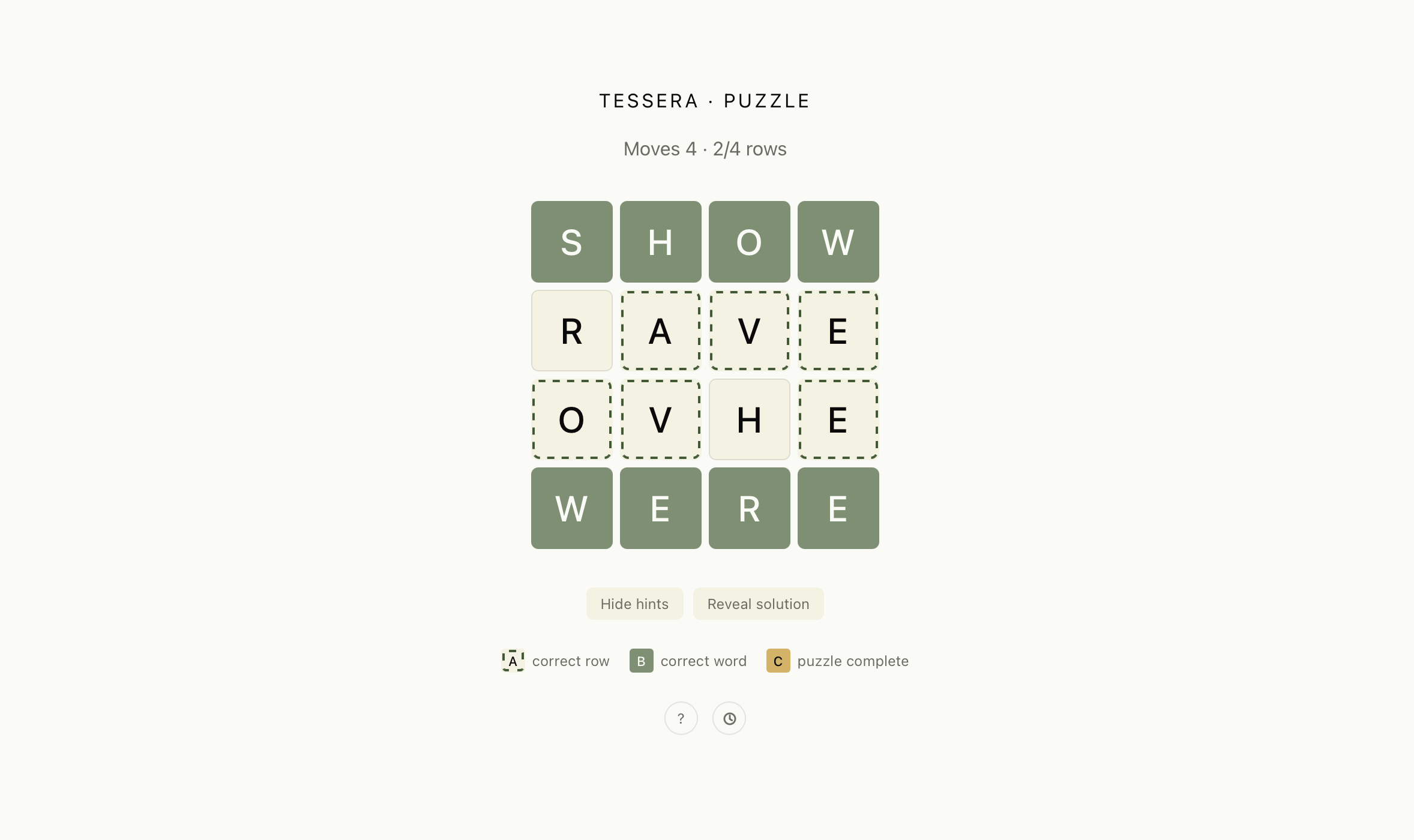
Tessera is a 4x4 grid where every row spells a four-letter word, and every column spells a four-letter word too. Players start with the letters scrambled and swap two tiles at a time to solve. There's one puzzle a day, the same for every player worldwide, resetting at midnight UTC. It takes about a minute to play, less if you're good. The whole thing lives at tesserapuzzle.com, with no app to download, no signup, and no ads.

Cooper built it solo over seven days as a self-directed challenge, using AI tooling end-to-end, design, code, dictionary curation, deployment, and a Spanish localisation that launched a few weeks later. It is the kind of project that, in 2023, would have taken six months of evenings.
The dictionary problem
The most interesting design problem turned out not to be the mechanic but the dictionary. Cooper's first prototype used SOWPODS, the official Scrabble word list, and kept generating puzzles where the gold solution was “ESES” or “PSST”. Technically valid four-letter words. Emotionally infuriating. He ended up curating a 2,000-word list using Wikipedia frequency data, intersected with SOWPODS, so that the puzzle's solutions are words people actually use. The top ten gold words are now AREA, ARIA, UREA, ENDS, ALOE, ELSE, IDEA, TSAR, ORAL, ILIA, words you'd recognise from a newspaper, not a Scrabble tournament.
4017
Full SOWPODS list
2000
Curated solution words
7 days
Solo build time
2
Languages live

Part of a seven-in-seven
Tessera was the most-played output of a seven-day sprint Cooper set himself for the challenge of it. One rule: ship something every day for a week. Public URL, real users where possible. The other six included a rebuilt portfolio, a pixel typeface, a browser stone-stacking toy, a long-shelved generative art collection finally relaunched, and a daily journal pipeline. The full field report is at pjcooper.design/blog/seven-in-seven. Tessera is the one that grew its own audience.
On AI as friction-removal
On the AI workflow, Cooper is careful to make a distinction that he says the broader discourse hasn't quite caught up with:
The AI didn't make the game. It removed the friction between having an idea and shipping it. That changes which projects get built. The threshold for ‘worth attempting’ just dropped a lot.
He's quick to add that AI didn't replace the design work, choosing the tier names (“Tenacious” instead of “Struggling” for the slowest solvers), the green-outline hint that signals warmth without giving the answer, the decision to use strict word matching over a more permissive rule, those decisions stayed entirely his. AI made him faster at the parts he was slow at, and exactly as fast at the parts that needed taste.
Tested in the family WhatsApp
Tessera didn't go from solo build to public launch in a vacuum. A small group of friends and family playtested it daily, hunted bugs, and pushed back on the difficulty curve. Several design decisions came directly out of that loop. The home-row hint, the green outline that nudges difficulty down for cold solvers, started life as a sister's complaint that the puzzle was “impossible from a fresh scramble.” The tier names were workshopped over text. The decision to guarantee at least one home tile in every starting row was a direct response to a friend hitting a dead-end column on day three.
The takeaway Cooper points to: AI shortened the loop between an idea and a playable build, but it was a handful of real humans, playing it every morning and saying what felt off, that turned a working prototype into something people actually want to come back to.
Spanish, separately curated
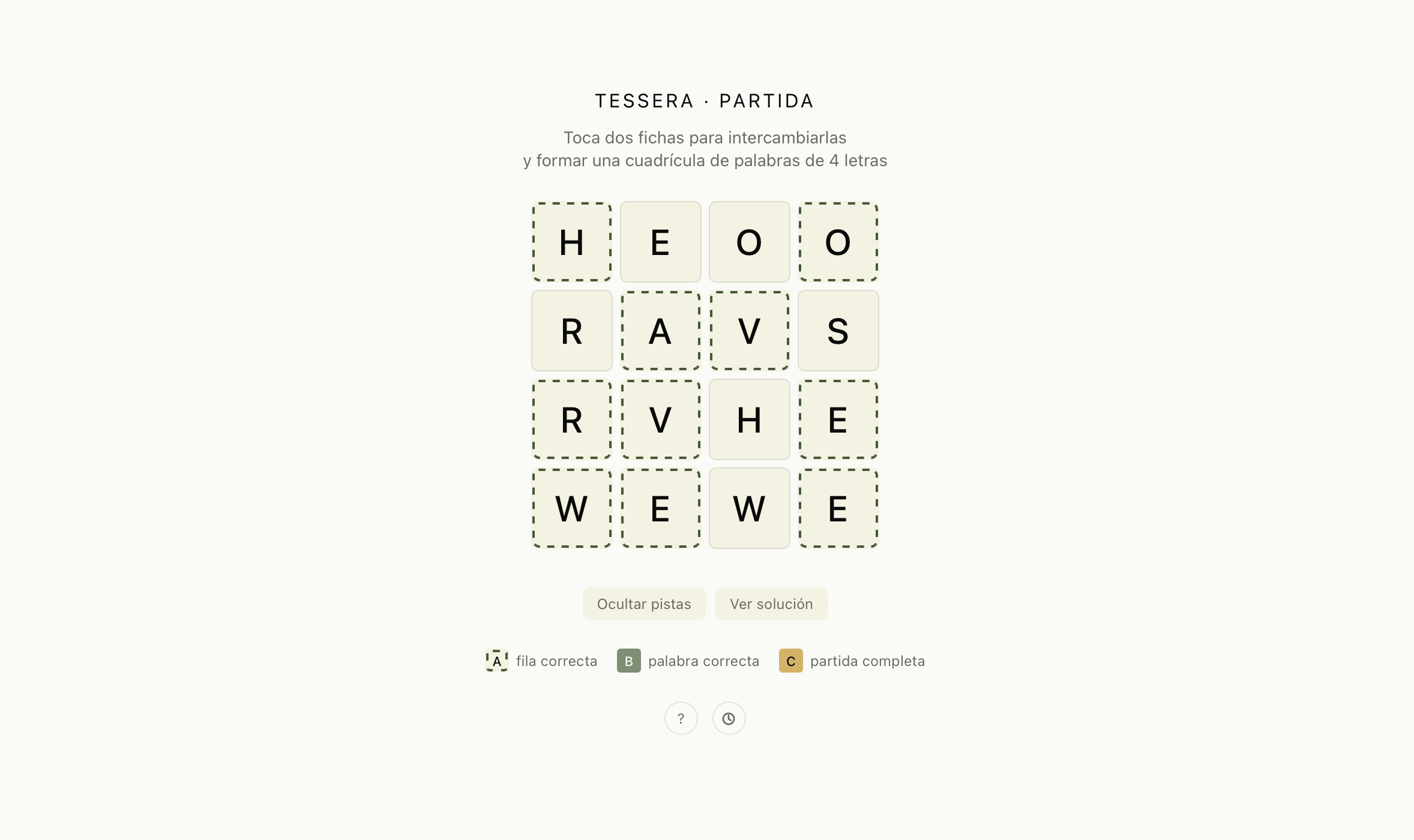
The Spanish version went live a week after the English launch, again because AI tooling made it cheap to attempt. It isn't a translation: it has its own separately curated dictionary, built the same way, frequency-ranked Spanish four-letter words intersected with a permissive base list, with proper nouns and unfamiliar forms removed. Cooper is currently looking for senior product design and UI engineering roles, and treats Tessera as a small piece of public evidence about how he works now. A more technical write-up of the build is at pjcooper.design/blog/meet-tessera.

Downloads
Hi-res screenshots and gameplay video, in light and dark variants. All assets free to use in coverage of Tessera with credit to Paul Cooper.
Light mode

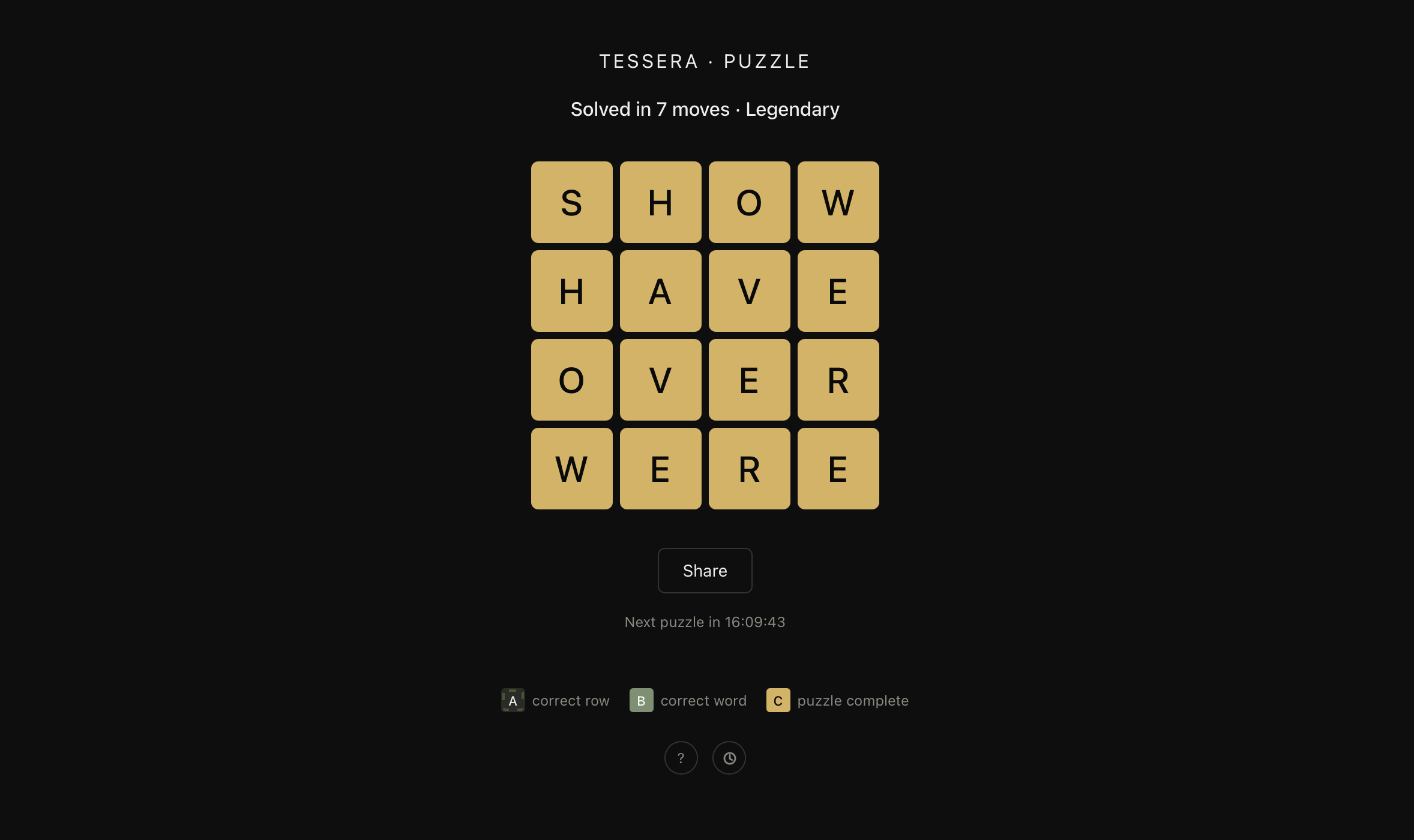
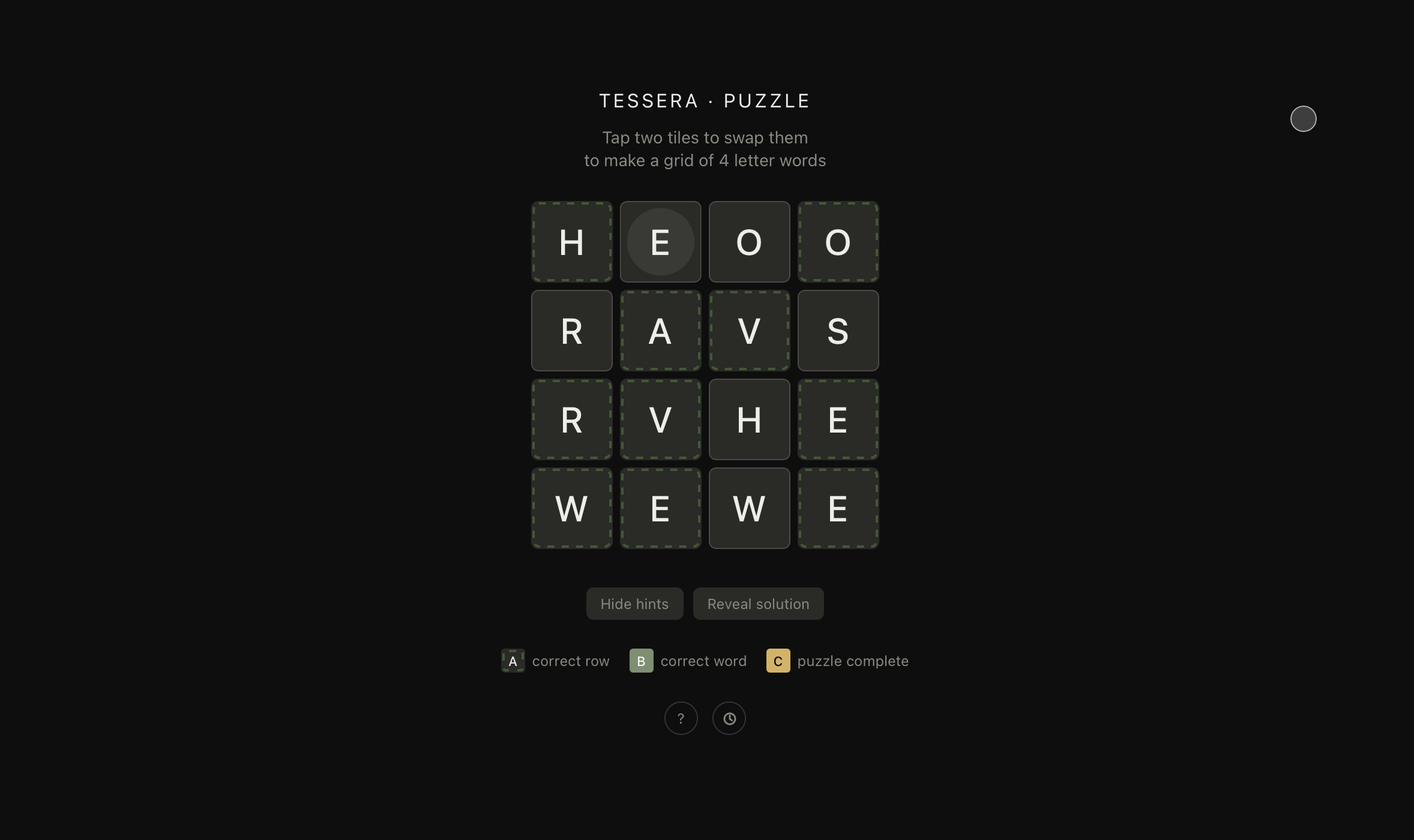
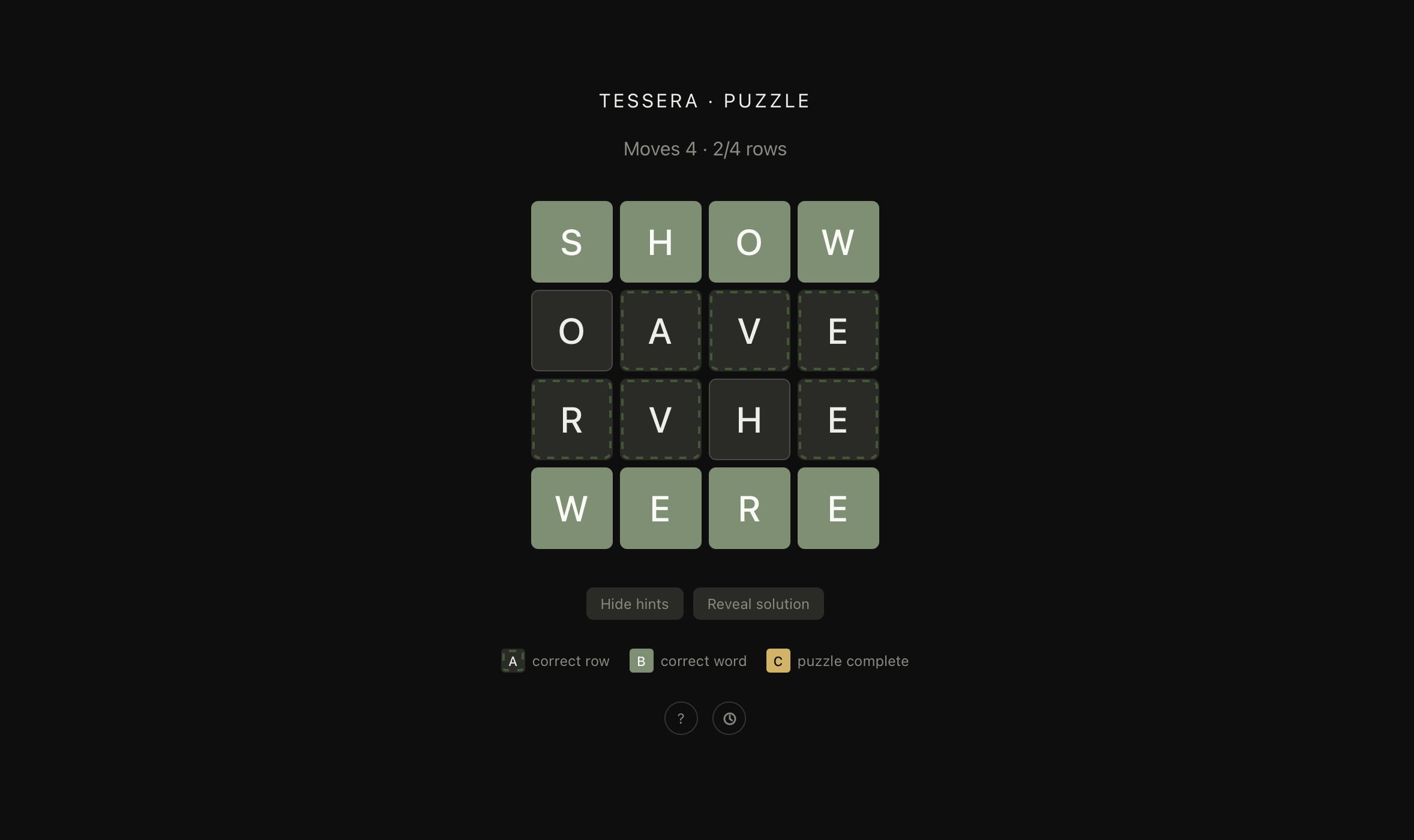
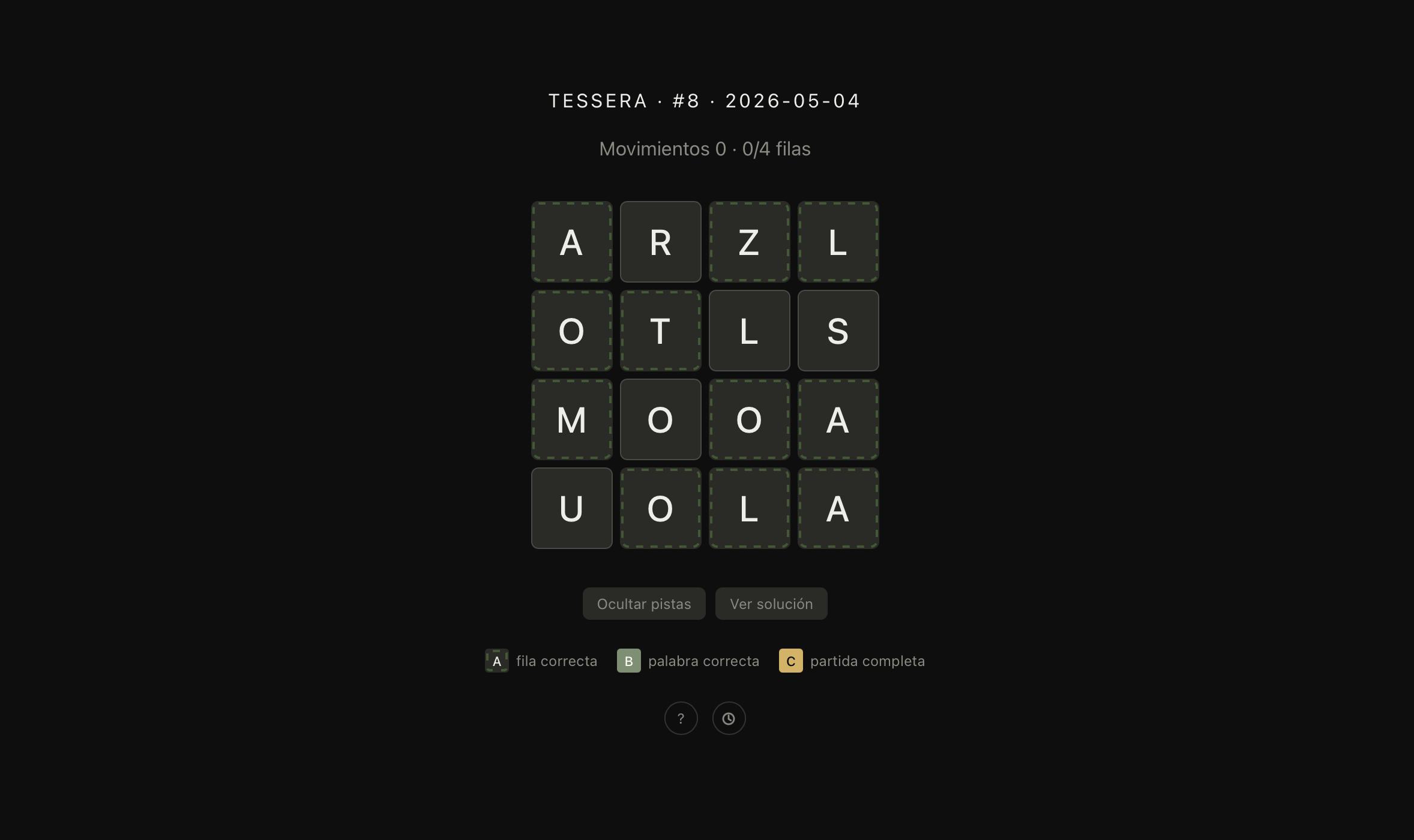

Story copy
The full press narrative as plain Markdown, free to quote with attribution.
Download press story (.md) ↓Play it
Press queries: paul@cooperbanfield.co.uk.